




Direktsändning / Podcast från Nyhetseko Radio.
Christine Djerf
Politik, Nyheter
# A Gift That Raises Questions
## Erdoğan's NATO Gift Sparks Debate Over Symbolism and Diplomacy
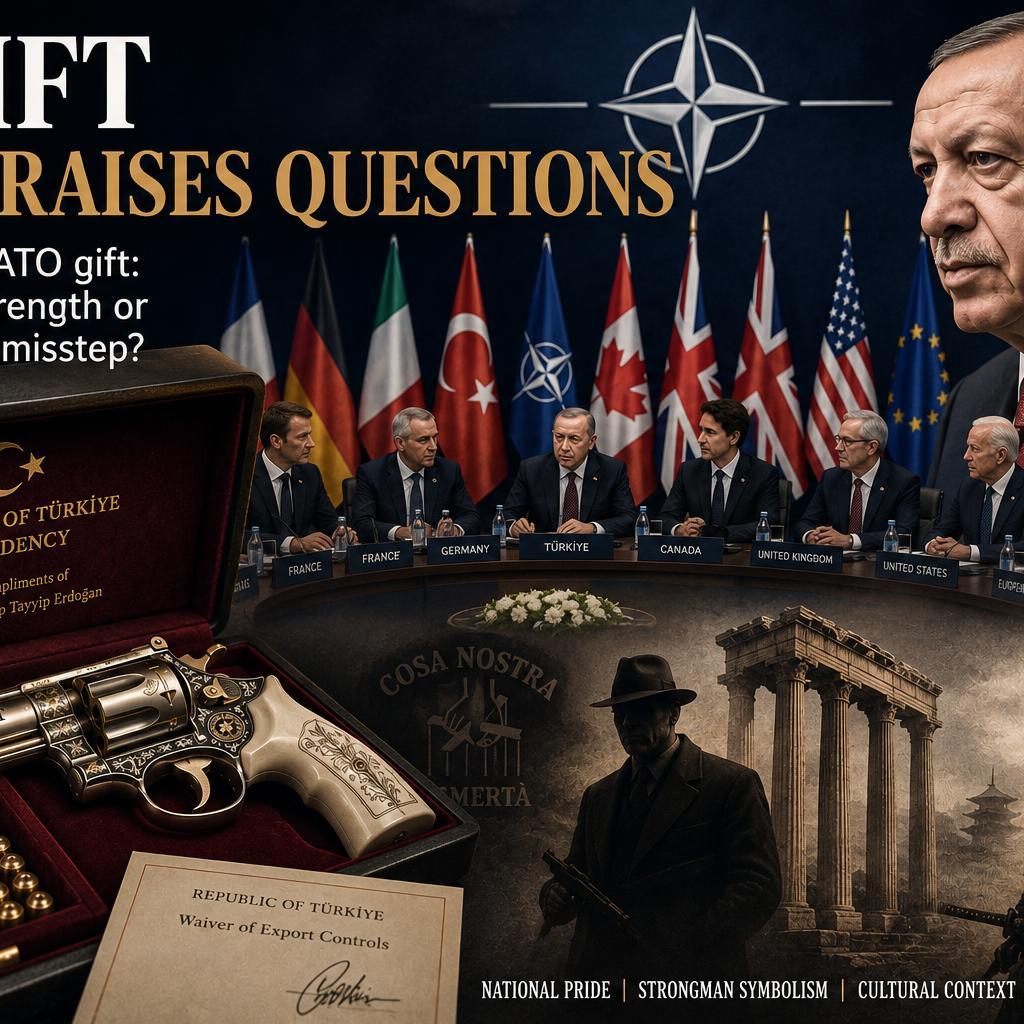
When NATO leaders gathered in Ankara, they were presented with an unexpected farewell gift. Turkish President Recep Tayyip Erdoğan handed each attending head of state and government a personalized, engraved revolver accompanied by a box of ammunition. While the gesture was intended to showcase Turkey's defense industry and domestic firearms manufacturing, it quickly ignited debate over symbolism, diplomatic protocol, and political messaging.
Official diplomatic gifts are typically works of art, cultural artifacts, or items representing a nation's heritage. A firearm is an extraordinary exception. Unsurprisingly, the presentation attracted immediate attention from political commentators and international media alike.
Many analysts have interpreted the gesture as a display of Turkey's growing military-industrial capabilities and strategic independence. The revolver, a Turkish-made Sarsılmaz SR38, can be viewed as a demonstration of national manufacturing strength rather than a conventional personal gift.
At the same time, the incident raises a broader cultural question. Throughout history, the act of presenting a weapon has often carried meanings far beyond the object itself. Stories from the Italian Mafia describe firearms or bullets being used as symbolic messages that someone was expected to take responsibility for failure. Similar associations with honor, duty, and self-sacrifice can also be found in Ancient Rome and within the traditions of Japan's samurai culture.
There is, however, no evidence that Erdoğan intended such a message. The revolvers were presented publicly to all participating leaders and were accompanied by official documentation allowing them to be exported from Turkey. The event therefore appears to have been a demonstration of national pride rather than a hidden diplomatic signal.
Ironically, the gift nevertheless created practical complications. Several recipient countries maintain strict laws governing the import and possession of firearms. British Prime Minister Keir Starmer was unable to take the revolver home without it first being decommissioned. Canadian Prime Minister Mark Carney's delegation immediately transferred the weapon to the Royal Canadian Mounted Police for official handling, while several European delegations faced similar customs and security challenges.
The episode illustrates how the same symbol can be interpreted very differently depending on cultural and political context. What one nation regards as a prestigious gift of honor may be perceived elsewhere as a security concern or a diplomatic miscalculation.
Perhaps that is why the story has attracted so much attention. Not because anyone seriously believes NATO leaders received a concealed ultimatum, but because the gift challenged the unwritten conventions that normally govern international diplomacy. When an object as symbolically charged as a firearm is exchanged between world leaders, questions about its intended meaning—and the meaning perceived by its recipients—become almost inevitable.
Listen to episode